
Structuring Math Scratch Work for Precision and Growth
Good Math Habits Series Part II

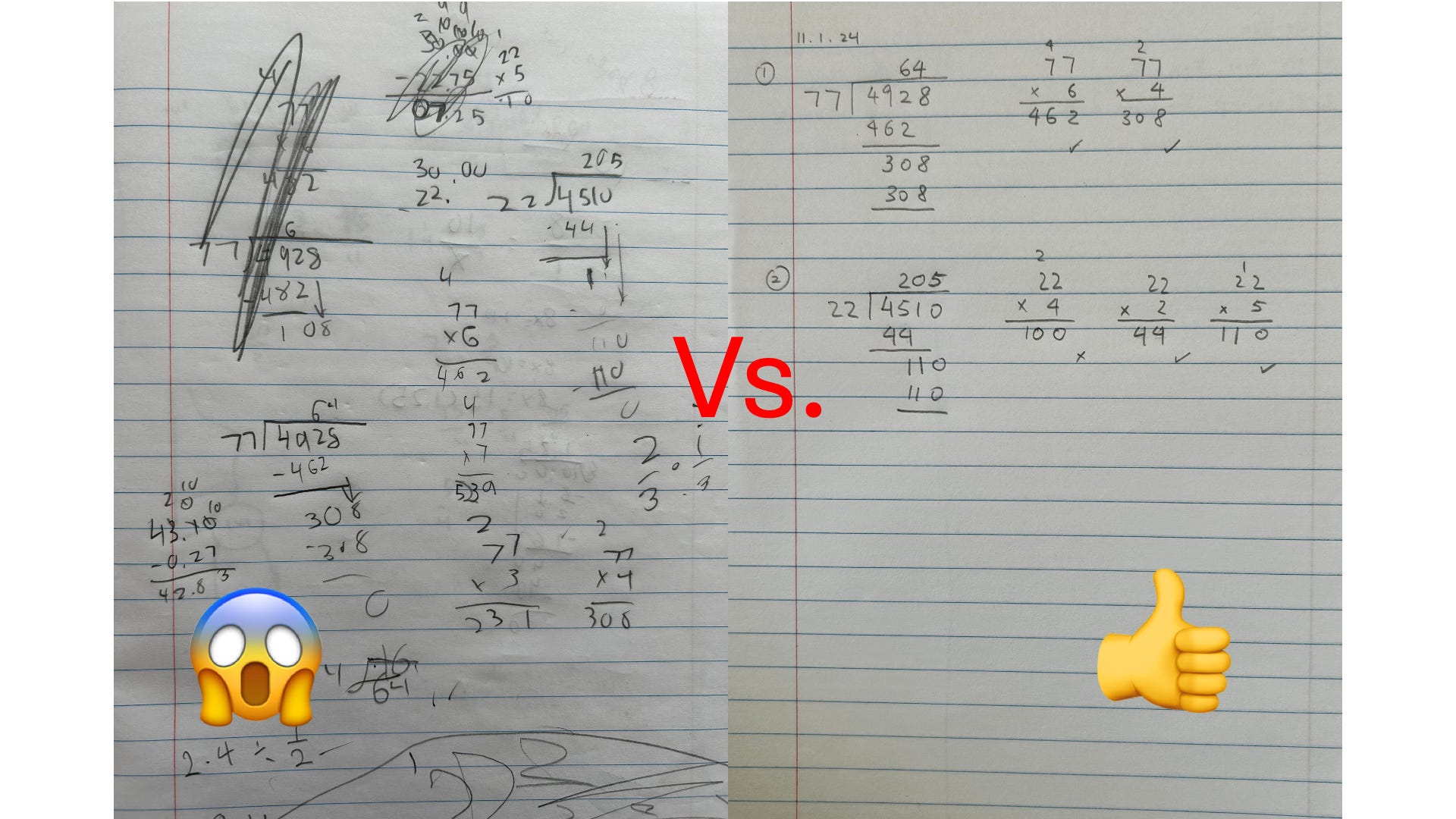
This is the second article in the series Good Math Habits, which aims to promote and nurture good habits among young math learners, primarily those in elementary schools.
Last time, I talked about why children’s scratch work is a valuable record of their thinking and reasoning, and it plays an equally important role in their math learning as their math textbook. A huge benefit would result if they build the habit of reviewing their math work, learning from their mistakes, recognizing their strengths and weaknesses, and guiding themselves to grow.
Today, I want to focus on helping children use a math workspace to guide the structure and flow of their mathematical reasoning.
What is a Math Workspace?
When learning a new math topic, elementary school students are often introduced to it by fill-in-the-blank problems, where parts of the full solution are provided. However, gradually, students will move on to problems that offer a completely blank space below, allowing them to solve each problem independently from start to finish. I want to call that space a math workspace.
Whether students will be able to present their thinking in an orderly and neat way in the math workspace or end up turning the workspace into a trash can full of their random thoughts depends on one thing: their ability to visualize math in their brains.
You may not see the term visualization very often in math textbooks, but it is a term every math learner should know. Solving a math problem means carrying out a series of cognitive operations, and a mature learner should be able to visualize the major steps in their head before attempting to solve the problem in writing.
Visualizing math does not refer to actual vision but the ability to predict mathematical outcomes, somewhat like an experienced artist usually has the final form of his painting in mind before starting to paint. But for young children, such ability is still developing, and they mature at different times. While advanced learners are ready to reap the flexibility of a blank space and utilize that fully to guide their reasoning, others may find the blank space daunting and get frustrated not knowing what to write.
Below, you can find my recommendations on how to utilize a math workspace effectively. The main goal behind this, apart from the obvious benefits of presenting neat math work, is to help students visualize the structure of a problem-solving process and minimize the chance of losing track of thoughts.
Good Habits in Using Math Workspace
1- Date you work, if possible.
Many coffee lovers find that a day won’t feel right without a cup of coffee in the early morning. Apart from the caffeine, a favorite warm drink is a nice routine to start a day to provide familiarity and comfort before embracing the challenge of a brand new day.
Likewise, it is beneficial for children always to start their math homework with a date. Beyond providing a timestamp, this routine will help them transition smoothly from whatever they have been doing to a calm, focused mental state for the cognitive challenge ahead.
2 - Compartmentalize the workspace.
Use imaginary lines to divide the workspace into at least two sessions to accommodate the thought structures needed for math problem-solving:
Session 1 (Main steps) - Use the left division of your math workspace for your major steps, for consistency and neatness.
Session 2 (Sub-steps) - Use the middle division, if necessary, for sub-steps that branch out from the main steps.
Session 3 (Diagrams) - Use the right division, if necessary, for illustrative diagrams.
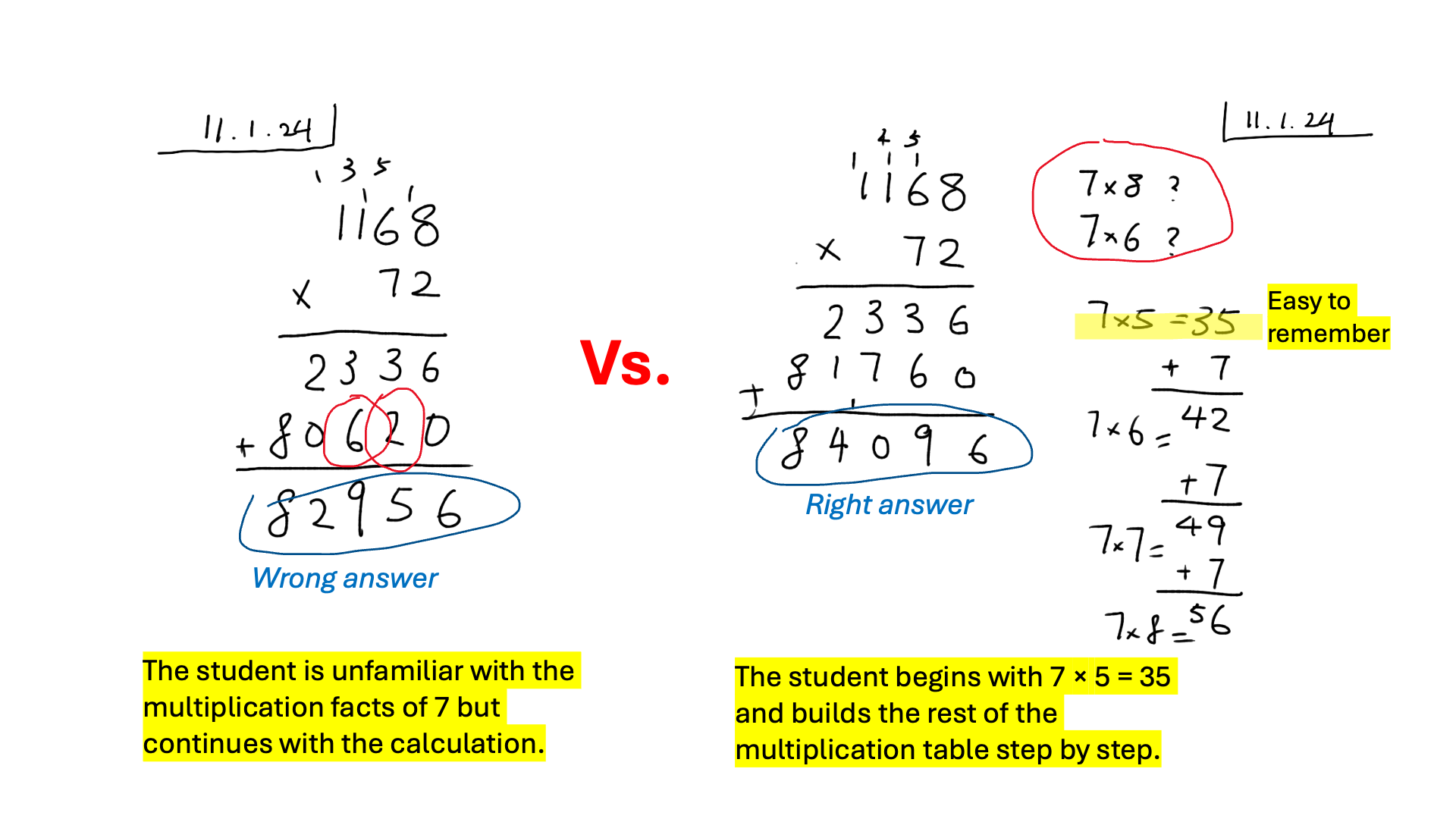
Many elementary school children do not have structures in their math thinking. Let’s say I am asked to do 1168*72, and up to the point where I need to do 7*8, I feel hesitant. Then what should I do? Ideally, I should branch out at this point and do something to help me confirm, with confidence, what 7*8 is before I continue. I would start in a separate session of the math workspace, write down a multiplication of 7, which I am fully confident of, say 7*5=35, and work my way up to 7*8, by adding 7. This is a nice way to confidently process the difficulty at hand and solve my math problem step-by-step.
Yet, most students feel hesitant to “branch out” their thinking at a young age, as they feel like they will lose track of their thoughts. Many math teachers do not emphasize and help students build structures in their problem-solving skills. As a result, students have the habit of “keep going” even when they have uncertainty in a sub-step, thus carrying forward a math uncertainty throughout the rest of the calculation. Such habits do a lot of harm, shattering children’s confidence not just in doing math but also in managing self-doubt.
Therefore, I recommend telling students to allocate space for their major steps and sub-steps as a habit to help them realize the importance of having a structure in their thought process.
3 - Pause, when your mind goes blank.
As I said before, students should not have the habit of “keep going” when they are uncertain. Instead, they should use separate sessions to resolve the uncertainty. If, after several attempts, they are still stuck in a sub-step, what should they do?
Let me tell you what I would do. I would pause, and NOT cross out the failed attempts. This is really important.
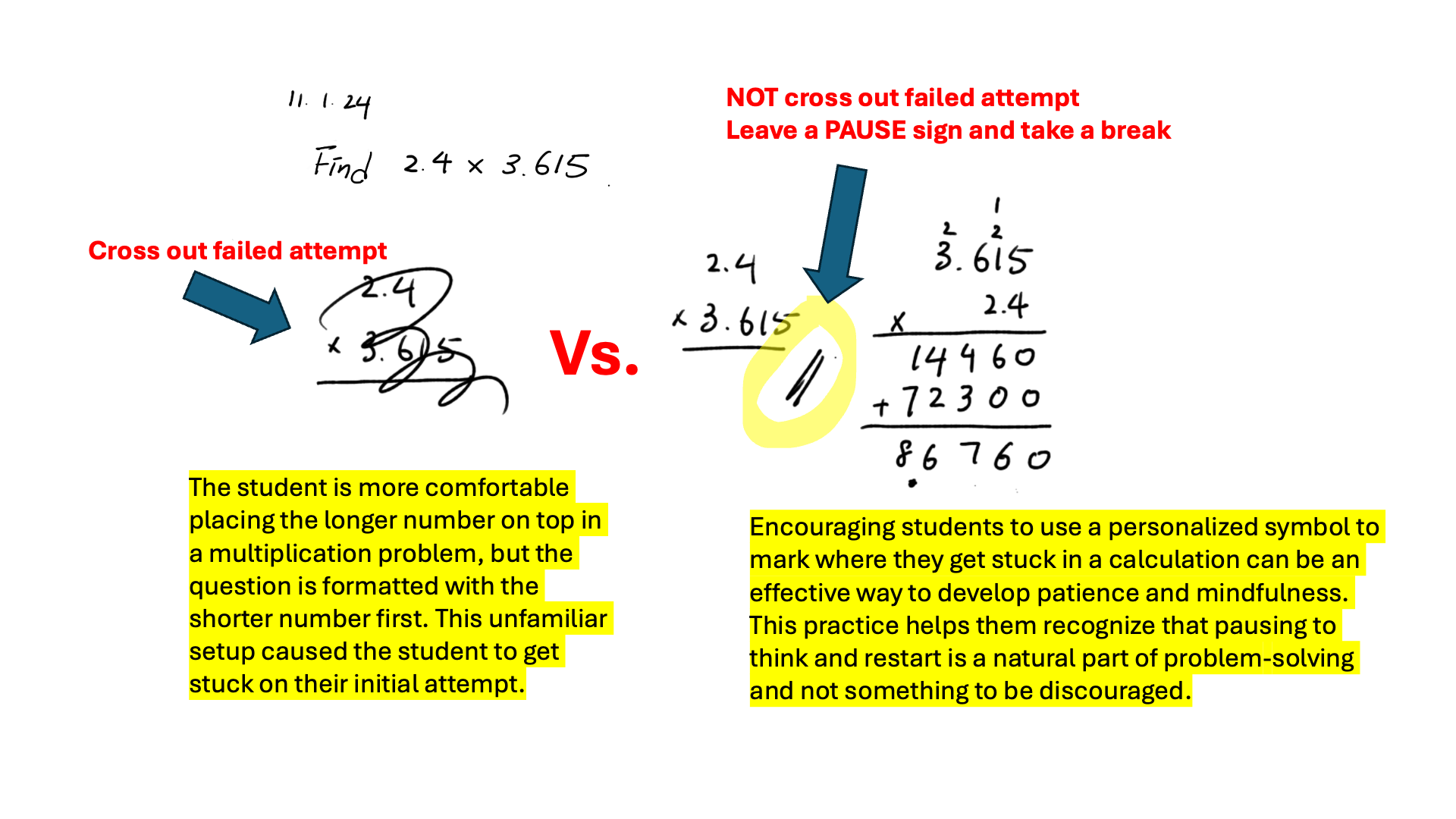
Having the confidence to pause a problem-solving process is a form of emotional intelligence; I am not joking. Some kids, like my daughter, lose patience and temper when they are stuck in the middle of calculation and start crossing out their failed attempts. As I stressed before, doing math requires a lot of psycho strengths. Accepting failure is part of doing math, and that’s no shame in it.
To help our students handle the frustrating feeling of defeat, I suggest everyone should have their customized “Pause” sign. My personal one is //. I use // to tell myself I need to pause here, and I will come back to it. Whenever I looked back at my old math work, I would see these pause signs and recall the time and effort I had put in to finish the problems. This is an important “sign” in my own learning journey, and I wish more young students would take the benefits of it.
4 - Maintain math precision all along.
Equal signs and units are important elements of a math problem, yet some students have the habit of losing them mid-way through their calculations, or even worse, never bother to write them down, like this:
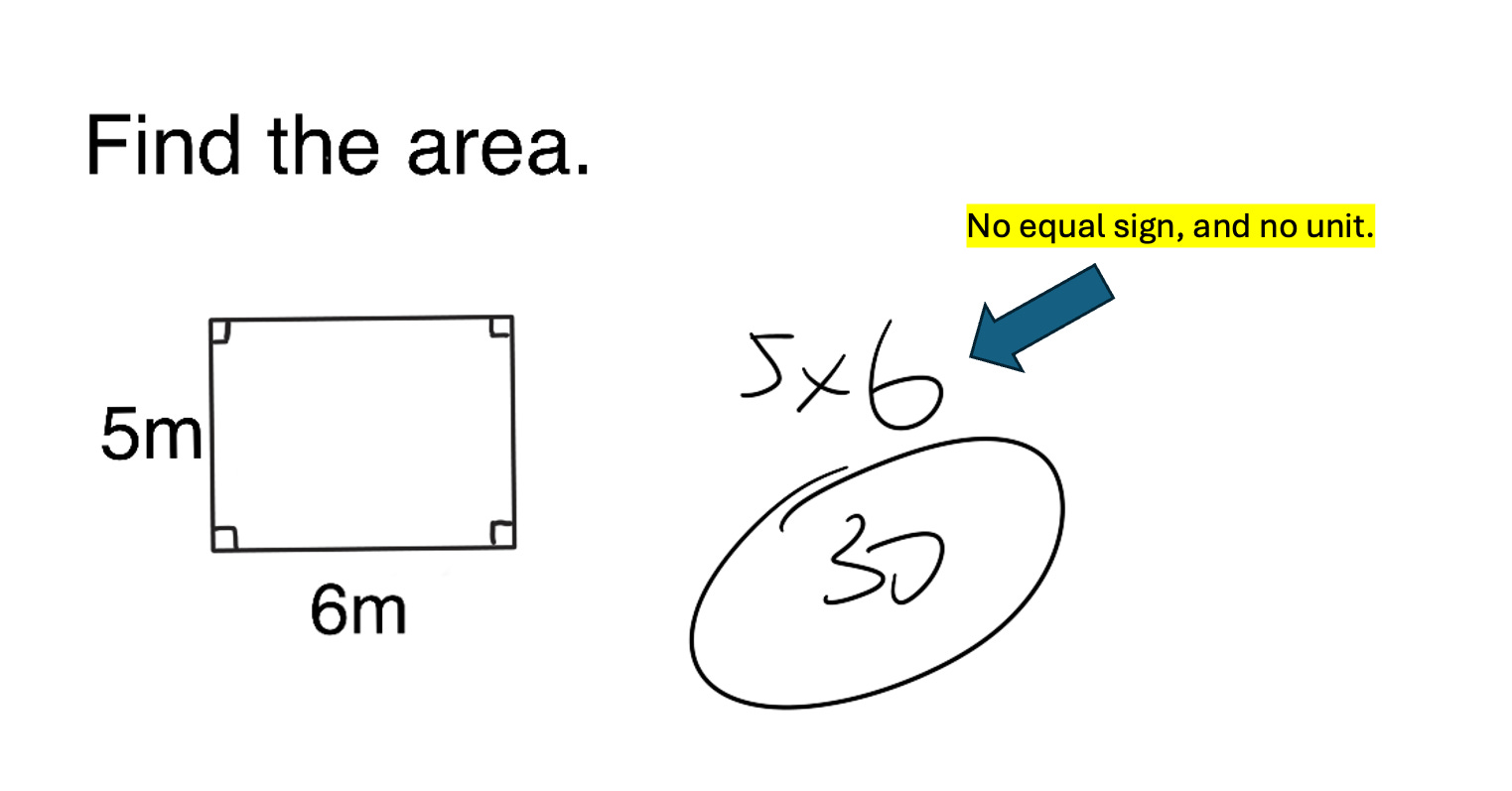
Students who do not make an effort to carry along equal signs and dimensions have, what I call, precision deficiency.
Just like vitamin deficiency, it may not immediately pose an urgent threat to our health, but prolonged negligence eventually will. Precision deficiency in math is similar. In elementary school, students primarily work on arithmetic, and when they are lazy, they will simply write 5*6 and 30 next to it instead of a proper statement 5*6=30. They don’t see the big deal of missing the equal sign. Little do they know that a lack of precision is lethal as they move on to algebra, geometry, and calculus.
Achieving precision in math requires a full understanding of the abstract definitions and relationships concerned instead of simple fact recalling like “5 times 6 is 30”. People sometimes call those deeper aspects of cognitive processing “higher-order” thinking, but the terms lack an exact definition in general.
Achieving precision in math also takes discipline and focus, such training boosts children’s performance in other subjects, like music, and builds self-confidence.
Advanced students who have already demonstrated proficiency in mastering basic arithmetics should be encouraged to engage in a mindful practice of mathematical precision, for it has obvious benefits.
Final Thoughts
Remember, nurturing good math habits takes time and patience, but the long-term benefits are well worth the effort. Encouraging children to value their math workspace and approach their work with a mindful, structured mindset sets the foundation for more advanced problem-solving skills and greater confidence in their mathematical abilities.
Stay tuned for the next article in the Good Math Habits series, where we’ll explore strategies to manage mistakes.
Until next time, let math shine your thoughts and build your life.